
Blog
Wood vs Metal Furniture for Dubai Offices: Complete 2026 Comparison Guide

The wood vs metal furniture debate is one of the most practically important decisions Dubai office designers and procurement managers face — yet it receives far less analytical attention than questions about brand, price, or style. Choose the wrong material for the wrong application and you face accelerated deterioration in Dubai’s demanding climate, mismatched aesthetics that undermine brand positioning, or structural limitations that restrict workspace functionality. Choose thoughtfully, and your wood vs metal furniture decision becomes a decade-long asset that serves both functional and brand objectives simultaneously.
This comprehensive wood vs metal furniture guide is built specifically for Dubai’s business environment in 2026. At Cosmo Furniture Store, we design and manufacture office furniture in Dubai using both material families — giving us direct, practical insight into where each material genuinely excels and where each creates avoidable problems. Whether you’re furnishing a startup’s first office or redesigning a corporate headquarters, this wood vs metal furniture comparison gives you the framework to make material decisions you won’t regret.
Quick Summary: Wood vs Metal Furniture for Dubai Offices
Before exploring the detailed wood vs metal furniture analysis, here’s the essential framework most successful Dubai office designers apply:
- Wood furniture wins on: Warmth and aesthetic sophistication, sound absorption, brand positioning for professional services, premium executive environments, and reception areas where first impressions drive business outcomes
- Metal furniture wins on: Structural strength for heavy-duty applications, hygienic easy-clean surfaces, industrial and tech aesthetics, height-adjustable mechanism reliability, and corrosion-managed utility furniture
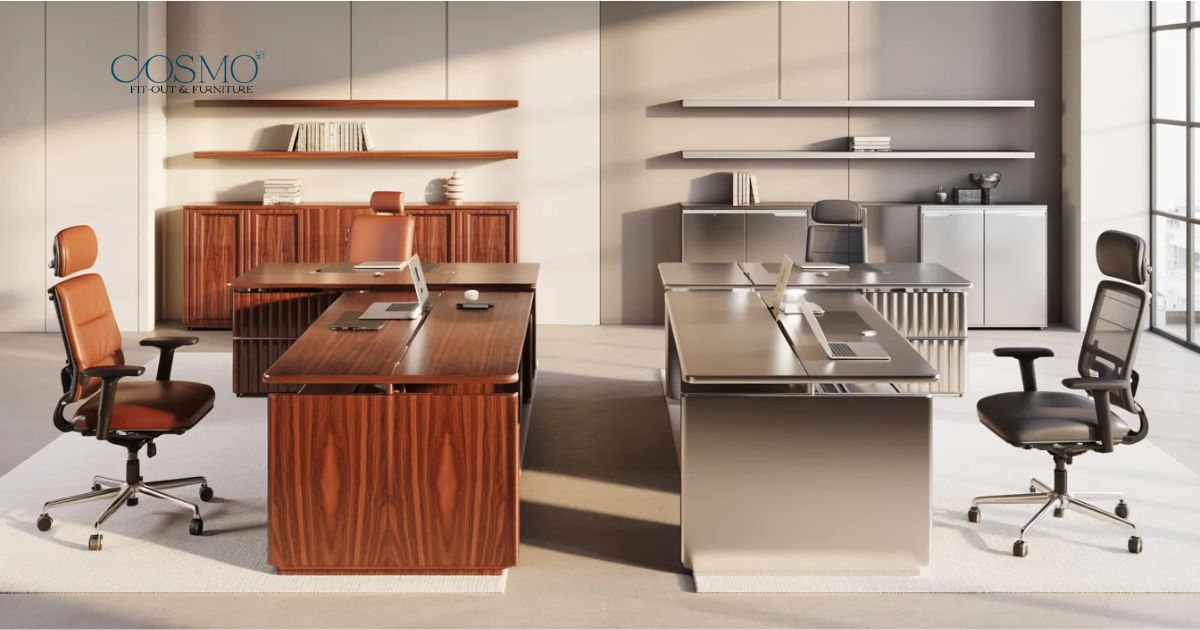
- Best approach for most Dubai offices: Hybrid material strategy — engineered wood surfaces for desk tops and visible furniture faces, powder-coated metal for structural frames and support systems — delivering the aesthetic warmth of wood with the structural reliability of metal
Understanding the Wood vs Metal Furniture Spectrum in Dubai
The wood vs metal furniture comparison in Dubai’s office market is more nuanced than the simple material choice suggests. Both material families span wide quality and application ranges that behave very differently in UAE conditions:
Wood Office Furniture — What It Actually Covers
In the Dubai wood vs metal furniture context, “wood” encompasses several distinct material categories with very different performance characteristics:
- Solid hardwood: Teak, oak, walnut, and similar dense hardwoods. Exceptional durability and aesthetic depth. Most premium position in the wood vs metal furniture hierarchy — genuine solid wood furniture can last generations with proper care. However, solid wood requires careful humidity management in Dubai’s climate-controlled environments to prevent warping and cracking.
- Engineered wood veneer: MDF or plywood core with genuine wood veneer surface. Combines the aesthetic richness of real wood with dimensional stability superior to solid wood — making veneer a practical wood vs metal furniture choice for Dubai’s humidity-cycling environments. Used extensively in premium executive furniture and luxury reception pieces.
- MDF with laminate: The most common core material in quality office furniture. When combined with premium laminates — like German EGGER laminates used across Cosmo Furniture Store‘s complete range — MDF delivers excellent surface durability, consistent finish quality, and superior dimensional stability versus solid wood in Dubai’s climate. The dominant material in quality mid-range wood vs metal furniture solutions.
- Particle board with melamine: Budget-tier engineered wood. Adequate for low-stress applications but deteriorates rapidly under humidity cycling. The weakest wood option in the wood vs metal furniture spectrum for Dubai’s demanding conditions.
Metal Office Furniture — What It Actually Covers
The metal side of the wood vs metal furniture comparison similarly spans distinct categories:
- Powder-coated steel: The dominant metal in quality office furniture frames. Powder coating provides corrosion resistance essential for Dubai’s humidity conditions. Used for desk frames, workstation structures, chair bases, and storage cabinet bodies across quality mid-range wood vs metal furniture applications.
- Aluminum: Lightweight, naturally corrosion-resistant, and premium in finish quality. Common in chair bases, mechanism components, and contemporary furniture with visible structural elements. More expensive than steel but lower maintenance in the wood vs metal furniture long-term cost comparison.
- Stainless steel: Highest corrosion resistance, exceptional durability, and distinctive aesthetic. Used in premium furniture accent elements, reception desk features, and healthcare environments where hygienic surface requirements make stainless steel the appropriate wood vs metal furniture choice.
- Chrome-plated steel: Decorative metal finish common in chair legs, desk accents, and contemporary furniture details. Less durable than powder coating in UAE humidity conditions — chrome plating can pit and deteriorate faster than powder coat in the wood vs metal furniture durability comparison for Dubai specifically.
Wood vs Metal Furniture: Head-to-Head Comparison
The wood vs metal furniture decision requires honest evaluation across eight critical dimensions that directly affect how office furniture performs in Dubai’s unique business and climate environment:
Factor 1: Aesthetics and Brand Positioning
Aesthetics is where the wood vs metal furniture comparison most clearly expresses different brand personalities. Wood — whether solid, veneered, or quality laminate — communicates warmth, permanence, sophistication, and human-centered organizational values. Metal communicates precision, modernity, efficiency, and technological confidence.
In the wood vs metal furniture aesthetic comparison for specific Dubai business contexts:
- Professional services (law, finance, consulting): Wood tones signal heritage, stability, and trustworthiness — directly supporting client confidence building that drives revenue in these sectors. Reception and executive furniture in warm wood aesthetics consistently outperforms cold metal in professional services brand positioning.
- Technology companies: Metal and mixed-material aesthetics communicate innovation, efficiency, and forward-orientation that aligns with tech brand values. Height-adjustable wood vs metal furniture solutions with powder-coated frames and clean laminate surfaces are particularly popular in Dubai’s thriving tech sector.
- Creative and design agencies: The wood vs metal furniture aesthetic choice for creatives often blends both — reclaimed wood surfaces on metal industrial frames, for example — creating the authentic, non-corporate identity that distinguishes creative workspaces from generic corporate environments.
- Healthcare and clinical environments: The wood vs metal furniture balance shifts toward metal-framed, easy-clean surfaces for clinical hygiene requirements while maintaining warm wood tones in patient reception areas where comfort and reassurance take priority over sterile functionality.
Factor 2: Durability in Dubai’s Climate
Dubai’s climate is the most important factor distinguishing the wood vs metal furniture comparison from equivalent analyses in temperate markets. UAE’s extreme conditions create specific challenges for both material families:
Wood furniture in Dubai’s climate: Natural wood movement — expansion and contraction in response to humidity and temperature changes — is significantly amplified by Dubai’s dramatic seasonal humidity swings (under 20% in winter, over 90% in summer). Solid wood furniture without proper climate acclimatization can warp, crack at joints, and suffer finish delamination. However, engineered wood products — particularly MDF with quality laminate — actually outperform solid wood in Dubai conditions because they have minimal natural movement and resist humidity cycling more effectively. In the wood vs metal furniture durability comparison for Dubai, the right engineered wood product outperforms solid wood and matches quality metal for most applications.
Metal furniture in Dubai’s climate: Corrosion is the primary climate challenge for metal in the wood vs metal furniture comparison for UAE. Bare steel in high-humidity environments oxidizes rapidly. However, powder-coated steel — the standard for quality office furniture frames — provides effective corrosion resistance even in Dubai’s challenging humidity conditions. Aluminum naturally resists corrosion and performs excellently in Dubai’s climate. Chrome finishes are more vulnerable — pitting and deterioration appear sooner in UAE conditions than European market benchmarks suggest.
The wood vs metal furniture climate durability conclusion for Dubai: quality engineered wood (MDF + German EGGER laminate) and powder-coated steel perform comparably and excellently. Solid wood requires humidity management. Chrome finishes underperform in UAE conditions. This climate analysis strongly favors the hybrid approach — engineered wood surfaces on powder-coated metal frames — that characterizes quality office furniture from manufacturers like Cosmo Furniture Store.
Factor 3: Structural Strength and Load Capacity
Structural performance is where the wood vs metal furniture comparison most clearly favors metal for specific applications. Steel and aluminum frames provide structural rigidity and load capacity that wood — particularly engineered wood — cannot match at equivalent section dimensions:
- Height-adjustable desks: The lifting mechanism and frame must support full desktop weight plus dual-monitor setups, equipment, and documents through thousands of adjustment cycles. Metal frames are the only practical choice in the wood vs metal furniture structural comparison for height-adjustable applications.
- Storage and filing systems: Metal filing cabinets and storage units support significantly higher static and dynamic loads than wood equivalents at comparable material costs — making metal the appropriate wood vs metal furniture choice for heavy-duty storage applications.
- Chair bases and mechanisms: All quality office chairs use metal bases regardless of aesthetic — the structural loads from daily seating make wood entirely inappropriate for chair structural components in the wood vs metal furniture analysis.
- Cantilever desk designs: Desks with cantilevered surfaces or asymmetric structural loads require metal frames — wood cannot provide the structural stiffness necessary for these configurations without unacceptable deflection.
For standard desk tops, workstation surfaces, cabinet doors, and visible furniture faces, the wood vs metal furniture structural comparison is more balanced. Quality engineered wood panels at appropriate thickness (minimum 18mm for desk surfaces) provide adequate structural performance for normal office use loads.
Factor 4: Sound Performance
Sound management is an underappreciated dimension of the wood vs metal furniture comparison — particularly relevant in Dubai’s open-plan office culture. The acoustic properties of wood and metal differ significantly:
Wood in the wood vs metal furniture acoustic comparison: Wood and engineered wood absorb sound energy rather than reflecting it — dampening the ambient noise amplification that affects open-plan productivity. Offices furnished predominantly with wood-toned surfaces consistently measure lower ambient noise levels than equivalent metal-intensive environments. This acoustic advantage of wood in the wood vs metal furniture comparison is particularly valuable in client-facing meeting rooms where conversation clarity affects professional impression.
Metal in the wood vs metal furniture acoustic comparison: Metal surfaces reflect sound — amplifying ambient noise in open-plan environments. Metal filing cabinets, steel storage systems, and metal-intensive workstation configurations contribute measurably to acoustic deterioration in open offices. For environments where sound management is a priority — which includes most professional client-facing Dubai offices — the wood vs metal furniture acoustic comparison favors wood surfaces for horizontal and vertical elements that dominate acoustic reflection.
Factor 5: Hygiene and Maintenance
Maintenance requirements represent a genuine practical difference in the wood vs metal furniture comparison for Dubai office environments. Metal surfaces — particularly stainless steel and powder-coated steel — are easier to clean and disinfect than wood surfaces:
- Metal maintenance in the wood vs metal furniture comparison: Powder-coated steel wipes clean with standard cleaning products. Stainless steel resists staining and bacterial growth. Aluminum anodized surfaces are similarly low-maintenance. For environments with elevated hygiene requirements — healthcare, food service, laboratory settings — metal surfaces in the wood vs metal furniture maintenance comparison offer clear advantages.
- Wood maintenance in the wood vs metal furniture comparison: Quality laminate surfaces on engineered wood are nearly as easy to clean as metal — resistant to standard cleaning products, non-porous, and stain-resistant when properly specified. Solid wood and veneer surfaces require more careful cleaning to avoid finish damage and moisture penetration. The wood vs metal furniture maintenance gap narrows significantly when quality laminate wood products are compared to metal rather than raw or poorly finished wood alternatives.
For Dubai offices requiring regular deep cleaning — corporate environments post-event, high-traffic reception areas, clinical spaces — the wood vs metal furniture maintenance comparison favors quality laminate wood or metal over solid wood or veneer for high-touch surfaces.
Factor 6: Weight and Mobility
Weight is a practical consideration in the wood vs metal furniture comparison for offices that reconfigure frequently or require flexibility for event hosting and collaborative space transformation:
Metal furniture — particularly aluminum-framed pieces — is typically lighter than equivalent solid wood pieces at comparable structural performance. However, engineered wood furniture at appropriate panel thickness is often lighter than heavy steel-framed alternatives. The wood vs metal furniture weight comparison is therefore more nuanced than the simple wood-is-heavier assumption suggests.
For stackable meeting room chairs, folding conference tables, and reconfigurable collaborative furniture — where mobility is a primary functional requirement — the wood vs metal furniture comparison favors lightweight metal or metal-framed designs that minimize handling effort during reconfiguration.
Factor 7: Cost Comparison
The wood vs metal furniture cost comparison depends heavily on material quality and application. General pricing relationships:
- Budget tier: Particle board with melamine (wood) and basic painted steel (metal) are comparably priced for equivalent functional pieces
- Mid-range quality: MDF with German EGGER laminate (wood) and powder-coated steel frame (metal) — hybrid products using both materials represent the dominant mid-range office furniture configuration in Dubai
- Premium tier: Solid hardwood commands significant premiums over equivalent metal alternatives. Veneer sits between solid wood and laminate in the wood vs metal furniture cost comparison
- Luxury tier: Bespoke solid wood or statement metal pieces (brushed brass, blackened steel) represent similar investment levels with different aesthetic outcomes
The most important wood vs metal furniture cost insight is that the best-value office furniture typically combines both materials — engineered wood surfaces with metal structural frames — rather than committing exclusively to either material family.
Factor 8: Sustainability Profile
Sustainability is an increasingly important dimension of the wood vs metal furniture comparison as Dubai businesses align with global ESG frameworks and UAE Vision 2031 sustainability commitments:
Wood sustainability in the wood vs metal furniture comparison: FSC-certified wood and engineered wood products from sustainable forestry represent positive environmental positioning. Wood sequesters carbon through its lifecycle — a genuine climate benefit that supports ESG reporting. However, deforestation risk from uncertified sources and the chemical treatments applied to engineered wood products require careful specification in wood vs metal furniture sustainability analysis.
Metal sustainability in the wood vs metal furniture comparison: Steel and aluminum are among the most recyclable materials globally — steel retains full recyclability indefinitely and aluminum recycling uses 95% less energy than primary production. For organizations tracking circular economy metrics, the end-of-life recyclability of metal in the wood vs metal furniture sustainability comparison offers clear advantages.
The wood vs metal furniture sustainability conclusion: both materials offer defensible environmental positions when properly sourced and specified. FSC-certified engineered wood products and recycled-content powder-coated steel represent the best environmental positioning for each material family in Dubai’s ESG-conscious business environment.
Wood vs Metal Furniture: Application Guide by Office Area
The most practical resolution of the wood vs metal furniture question is understanding which material — or material combination — serves each specific office area optimally:
Reception Areas — Wood Warmth Wins
Reception is where the wood vs metal furniture comparison most clearly favors warm wood aesthetics for most Dubai business environments. A Modern Reception Desk Dubai in warm laminate or veneer finishes creates an immediately welcoming, professional impression that cold metal alternatives cannot replicate. Visitors form brand impressions within seconds of entering a reception space — and warm wood tones consistently test more positively for trust, professionalism, and organizational stability than cold metal surfaces in client-facing reception environments.
The practical wood vs metal furniture solution for reception: engineered wood surfaces (MDF with premium laminate or veneer) on powder-coated metal internal structural support — delivering wood aesthetics with metal structural reliability in the UAE’s most client-visible office space.
Executive Offices — Premium Wood Preferred
Leadership offices sit firmly in wood territory in the wood vs metal furniture comparison for most Dubai business contexts. A premium Executive Office Desk Dubai in walnut veneer, dark laminate, or rich wood-toned finish communicates authority and permanence that metal alternatives cannot achieve with equivalent visual impact. The warmth and depth of quality wood surfaces in the wood vs metal furniture comparison creates executive environments that signal organizational maturity — particularly important in client-facing CEO and director offices.
Workstations — Hybrid Optimal
Team workstations represent the clearest hybrid application in the wood vs metal furniture comparison. Quality Office Workstation Table Dubai systems use engineered wood surfaces — MDF with German EGGER laminates in 100+ colors — for desk tops, partition panels, and visible storage faces, combined with powder-coated steel frames for structural support. This hybrid approach in the wood vs metal furniture comparison delivers wood warmth at the surfaces employees interact with daily, and metal structural reliability in the supporting infrastructure that bears loads and provides long-term dimensional stability.
Conference and Meeting Rooms — Wood for Client Rooms, Hybrid for Internal
The wood vs metal furniture decision for meeting spaces depends on meeting purpose and audience. Client-facing boardrooms benefit from warm wood conference table tops and quality Best Meeting Room Chairs Dubai with wood-toned accents — creating professional, welcoming environments that support important business discussions. Internal team meeting rooms used exclusively by employees are appropriately furnished with hybrid or metal-framed solutions where durability and easy reconfiguration outweigh aesthetic premium.
Storage and Filing — Metal Practical Choice
Filing cabinets, storage towers, and utility storage systems are where the wood vs metal furniture comparison clearly favors metal for most applications. Metal storage is stronger, more resistant to heavy loading, easier to clean, and more fire-resistant than equivalent wood alternatives. For back-of-office storage that clients never see and employees access daily, metal represents the practical wood vs metal furniture choice without meaningful disadvantage.
Height-Adjustable and Ergonomic Furniture — Metal Essential
For height-adjustable desks, ergonomic chair frames, and mechanism-intensive furniture, the wood vs metal furniture comparison is not a genuine choice — metal is the only appropriate structural material. Height-adjustable desk mechanisms require metal frames and columns for load-bearing and adjustment cycle reliability. Ergonomic chair mechanisms use metal components throughout. The wood vs metal furniture distinction in these applications is primarily aesthetic — wood-look laminate surfaces on metal frames, or all-metal industrial aesthetics — rather than structural.
The Hybrid Approach: Resolving the Wood vs Metal Furniture Decision
The most important insight in the wood vs metal furniture comparison is that the best-performing office furniture in Dubai’s environment rarely uses either material exclusively. The hybrid approach — combining engineered wood surfaces with metal structural systems — resolves the wood vs metal furniture dilemma by delivering the genuine advantages of each material while mitigating the limitations of both:
Why Hybrid Resolves the Wood vs Metal Furniture Debate
- Aesthetic warmth from wood surfaces at the human interaction points — desk tops, panel faces, door fronts, and visible storage surfaces where material warmth affects daily experience and brand perception
- Structural reliability from metal frames at the load-bearing and dimensional stability points — desk underframes, workstation support systems, and storage structure where metal’s strength and climate resistance outperform wood
- Climate performance — quality engineered wood surfaces resist Dubai’s humidity cycling while powder-coated metal frames provide corrosion-resistant structural integrity through UAE’s demanding conditions
- Cost efficiency — hybrid construction typically delivers better value in the wood vs metal furniture cost comparison than premium all-wood or all-metal alternatives at equivalent quality levels
At Cosmo Furniture Store, our entire range of modern office furniture in Dubai applies this hybrid principle — German EGGER laminate surfaces on powder-coated steel frames — delivering the warmth, durability, customization, and climate performance that Dubai office environments require regardless of where each piece sits in the wood vs metal furniture spectrum.
Wood vs Metal Furniture: Industry-Specific Recommendations
Different Dubai industries have distinct wood vs metal furniture requirements based on client expectations, regulatory environments, and workplace culture:
Financial Services and Legal
The wood vs metal furniture balance for finance and legal firms strongly favors warm wood aesthetics across all client-visible spaces. Dark wood tones — walnut, mahogany, or rich laminate equivalents — signal the heritage, stability, and trustworthiness these sectors require to justify premium fees and maintain client confidence. Metal accents in brushed brass or dark bronze complement wood-primary wood vs metal furniture schemes in premium financial and legal offices without undermining the warmth that client trust building requires.
Technology and Innovation Companies
Tech companies in Dubai’s thriving innovation ecosystem typically favor contemporary wood vs metal furniture combinations — light wood tones (natural oak laminates, light grey) with powder-coated white or black metal frames. This material combination in the wood vs metal furniture spectrum communicates modernity and efficiency while avoiding the cold industrial aesthetic that pure metal schemes can create in workspaces designed for extended creative work.
Healthcare and Clinical Environments
Clinical environments shift the wood vs metal furniture balance based on specific area function. Patient reception and consultation rooms benefit from warm wood-toned surfaces that create reassuring, non-clinical atmospheres despite their medical context. Treatment areas, nursing stations, and clinical utility spaces appropriately use metal or metal-framed, easy-clean surfaces where infection control requirements make the hygiene performance of metal in the wood vs metal furniture comparison the dominant decision criterion.
Hospitality and Luxury Retail
Premium hospitality and luxury retail environments in Dubai represent the highest-specification wood vs metal furniture application. Genuine solid wood — teak, oak, walnut — combined with premium metal accents (brushed brass, blackened steel, polished chrome) creates the material richness that luxury brand environments require. The wood vs metal furniture choice at this level is not a functional decision but a brand expression decision where material authenticity communicates quality values directly to discerning clients.
Wood vs Metal Furniture: Pricing Guide for Dubai
Understanding realistic pricing across the wood vs metal furniture spectrum helps businesses allocate budgets accurately:
Workstations
- Budget engineered wood: AED 800–2,000 per station — particle board with melamine, painted steel frame
- Quality hybrid (wood surface + metal frame): AED 2,500–6,000 per station — German EGGER laminate, powder-coated steel
- Premium all-wood: AED 6,000–12,000+ per station — solid or veneered surfaces, hardwood accents
Executive Desks
- Quality laminate wood: AED 3,500–10,000 — premium laminate finish, metal frame
- Veneer wood: AED 8,000–20,000 — genuine veneer surface, engineered core
- Solid wood bespoke: AED 15,000–45,000+ — custom solid hardwood configurations
Storage Systems
- Metal filing cabinets: AED 700–2,500 — powder-coated steel, most practical choice
- Wood-faced metal storage: AED 1,500–4,000 — metal structure with laminate doors
- Solid wood storage: AED 3,000–8,000+ — premium aesthetic, lower load capacity
Key Takeaways: Wood vs Metal Furniture for Dubai Offices
The wood vs metal furniture decision is best resolved not as an either/or choice but as a material allocation strategy that applies each where it genuinely delivers superior outcomes:
- Wood surfaces win on aesthetics and brand warmth — in the wood vs metal furniture comparison, warm wood tones consistently outperform metal for professional trust building in client-facing Dubai office environments.
- Metal wins on structural strength and load capacity — frames, supports, storage systems, and mechanism-intensive furniture all perform better with metal in the wood vs metal furniture structural comparison.
- Hybrid construction resolves the wood vs metal furniture debate — quality engineered wood surfaces on powder-coated metal frames deliver the aesthetic advantages of wood and structural advantages of metal simultaneously.
- Dubai’s climate favors quality engineered wood over solid wood — in the wood vs metal furniture durability comparison for UAE conditions, MDF with German EGGER laminate outperforms solid wood by resisting humidity cycling that causes natural wood movement.
- Chrome deteriorates faster in UAE humidity — in the wood vs metal furniture climate comparison, powder-coated steel and aluminum significantly outperform chrome-plated finishes in Dubai’s humidity conditions.
- Wood absorbs sound, metal reflects it — in the wood vs metal furniture acoustic comparison, wood-dominant surface environments measure better ambient noise performance — particularly relevant for client-facing meeting and reception spaces.
- Application drives the right wood vs metal furniture choice — reception and executive offices favor wood warmth; storage and structural elements favor metal reliability; workstations and most functional furniture favor the hybrid approach.
- Partner with manufacturers who master both materials — suppliers like Cosmo Furniture Store who combine quality engineered wood surfaces with properly specified metal frames deliver the wood vs metal furniture performance that Dubai offices genuinely require.
Frequently Asked Questions: Wood vs Metal Furniture for Dubai Offices
Which is better for Dubai offices — wood or metal furniture?
Neither material exclusively — the optimal wood vs metal furniture solution for Dubai offices combines both through hybrid construction. Quality engineered wood surfaces (MDF with German EGGER laminate) provide warm aesthetics, sound absorption, and brand positioning value, while powder-coated metal frames provide structural strength, corrosion resistance, and dimensional stability through UAE’s demanding climate conditions. Most quality office furniture in Dubai already applies this hybrid wood vs metal furniture principle — wood-toned surfaces on metal structural systems.
Does wood furniture warp in Dubai’s humidity?
Solid wood can warp in Dubai’s dramatic seasonal humidity changes in the wood vs metal furniture climate comparison. However, quality engineered wood products — MDF with premium laminate finishes — are specifically designed to resist moisture movement and perform reliably through UAE’s humidity cycling. In the wood vs metal furniture durability comparison for Dubai specifically, quality engineered wood (MDF + German EGGER laminate) actually outperforms solid wood by eliminating the natural movement that causes warping in natural wood products.
Does metal furniture rust in Dubai?
Bare or poorly finished steel corrodes in Dubai’s humidity — but quality office furniture uses powder-coated steel that provides effective corrosion resistance in UAE conditions. In the wood vs metal furniture climate comparison, powder-coated steel and aluminum perform excellently in Dubai’s environment. Chrome-plated finishes are more vulnerable — pitting and deterioration appear faster in UAE humidity than in temperate markets. When evaluating wood vs metal furniture for Dubai, always specify powder coating rather than chrome for any metal components.
Which is more expensive — wood or metal office furniture in Dubai?
In the wood vs metal furniture cost comparison, solid hardwood commands the highest premium, followed by veneer, then quality laminate engineered wood. Metal pricing depends on finish quality — powder-coated steel is comparably priced to quality engineered wood at equivalent specification levels. The most cost-efficient wood vs metal furniture approach is hybrid construction — engineered wood surfaces on powder-coated steel frames — which delivers professional quality at better value than either all-wood or all-metal alternatives at comparable specification levels.
What type of wood office furniture lasts longest in Dubai?
In the wood vs metal furniture durability comparison for Dubai’s specific climate, MDF with German EGGER laminate finishes outperforms solid wood for dimensional stability and resists UAE’s humidity cycling most effectively. Teak and similar dense hardwoods perform better than most other solid woods in Dubai conditions due to natural oil content that resists moisture penetration. Veneer on engineered core sits between solid wood and laminate in the wood vs metal furniture durability spectrum — more stable than solid wood, more premium in aesthetic than laminate.
Is wood or metal furniture better for client-facing offices in Dubai?
In the wood vs metal furniture comparison for client-facing Dubai offices, warm wood aesthetics consistently deliver stronger trust and professionalism signals than metal alternatives. Reception desks, executive offices, and boardrooms furnished with quality wood-toned surfaces create environments that communicate stability, sophistication, and attention to quality — values that directly support client confidence and business development. Metal accents complement rather than replace wood in the wood vs metal furniture scheme for most professional service environments in Dubai.
Which is more sustainable — wood or metal office furniture?
Both materials offer defensible sustainability positions in the wood vs metal furniture comparison. FSC-certified wood and engineered wood products represent sustainable forestry commitment and carbon sequestration benefit. Steel and aluminum are among the most recyclable materials globally — steel retains full recyclability indefinitely and recycled aluminum production uses 95% less energy than primary production. For Dubai businesses tracking ESG metrics, FSC-certified laminate wood products and recycled-content powder-coated steel represent the best environmental positioning in the wood vs metal furniture sustainability comparison.
Can I see wood vs metal furniture options before ordering in Dubai?
Yes — Cosmo Furniture Store‘s Al Barsha 1 showroom displays a comprehensive range of wood vs metal furniture options across both material families and our complete hybrid product range. You can experience material quality, assess color accuracy under real lighting, and evaluate ergonomic comfort firsthand before committing to any wood vs metal furniture decision. For pieces not on showroom display, our team provides detailed material samples and free 3D visualization of your proposed furniture in your actual space. Call +971 55 145 2819 to schedule a wood vs metal furniture consultation at our Dubai showroom.
Conclusion: Making the Right Wood vs Metal Furniture Decision for Your Dubai Office
The wood vs metal furniture decision is ultimately a material allocation question rather than a binary choice — and the answer for most Dubai offices is not wood or metal but wood and metal, strategically combined through hybrid construction that delivers the genuine advantages of each material where they matter most.
Apply warm wood aesthetics at the surfaces that communicate brand values and create human-centered environments — reception desks, executive office tops, visible storage faces, and client meeting surfaces. Apply metal structural reliability where loads are borne, mechanisms operate, and dimensional stability is critical — frames, support systems, storage structure, and mechanism-intensive furniture. The wood vs metal furniture resolution is not compromise — it’s optimization.
Dubai’s climate reinforces this hybrid conclusion in the wood vs metal furniture analysis. Quality engineered wood surfaces resist humidity cycling that challenges solid wood. Powder-coated metal frames resist corrosion that challenges bare steel. Together, the right wood vs metal furniture material combination delivers decade-long performance in UAE’s demanding environment without the limitations of either material used exclusively.
At Cosmo Furniture Store, our complete range of luxury office furniture Dubai applies this hybrid wood vs metal furniture principle — German EGGER laminate surfaces on powder-coated steel frames, available in 100+ colors, with free UAE delivery and professional installation. Whether you need a warm wood-toned Modern Reception Desk Dubai, a premium Executive Office Desk Dubai in rich laminate or veneer finishes, a complete Office Workstation Table Dubai system, or quality Best Meeting Room Chairs Dubai in fabric or leather — our team helps you navigate the wood vs metal furniture decision with honest, experience-based guidance that serves your business interests.
Visit our showroom in Al Barsha 1, Dubai, call +971 55 145 2819, or explore our complete collection online. Our wood vs metal furniture specialists will help you make material decisions you’ll appreciate for the next decade.
Visit Our Showroom: Pin Location 📍
In Case You Missed These Posts:
- The Hidden Factors Behind Successful Workplace Transformations
- From Vision to Reality: Designing Workspaces That Inspire Productivity
- Inside the Makeover: How Dubai Businesses Are Redefining Professional Spaces
- How Can a Fitout Company Transform Your Spacе?
- Why Do You Need Office Furniture?
- The Importance of Fitout Services in Dubai for Modern Office Design
- Dubai’s Top Interior Design Services for Modern Spaces
- What Wood is Used for Furniture: Best Type to Choose for Office
- Zoning Workspaces with Innovative Furniture
- Can Interior Designers Help with Eco-Friendly Solutions?