Blog
The Hidden Factors Behind Successful Workplace Transformations

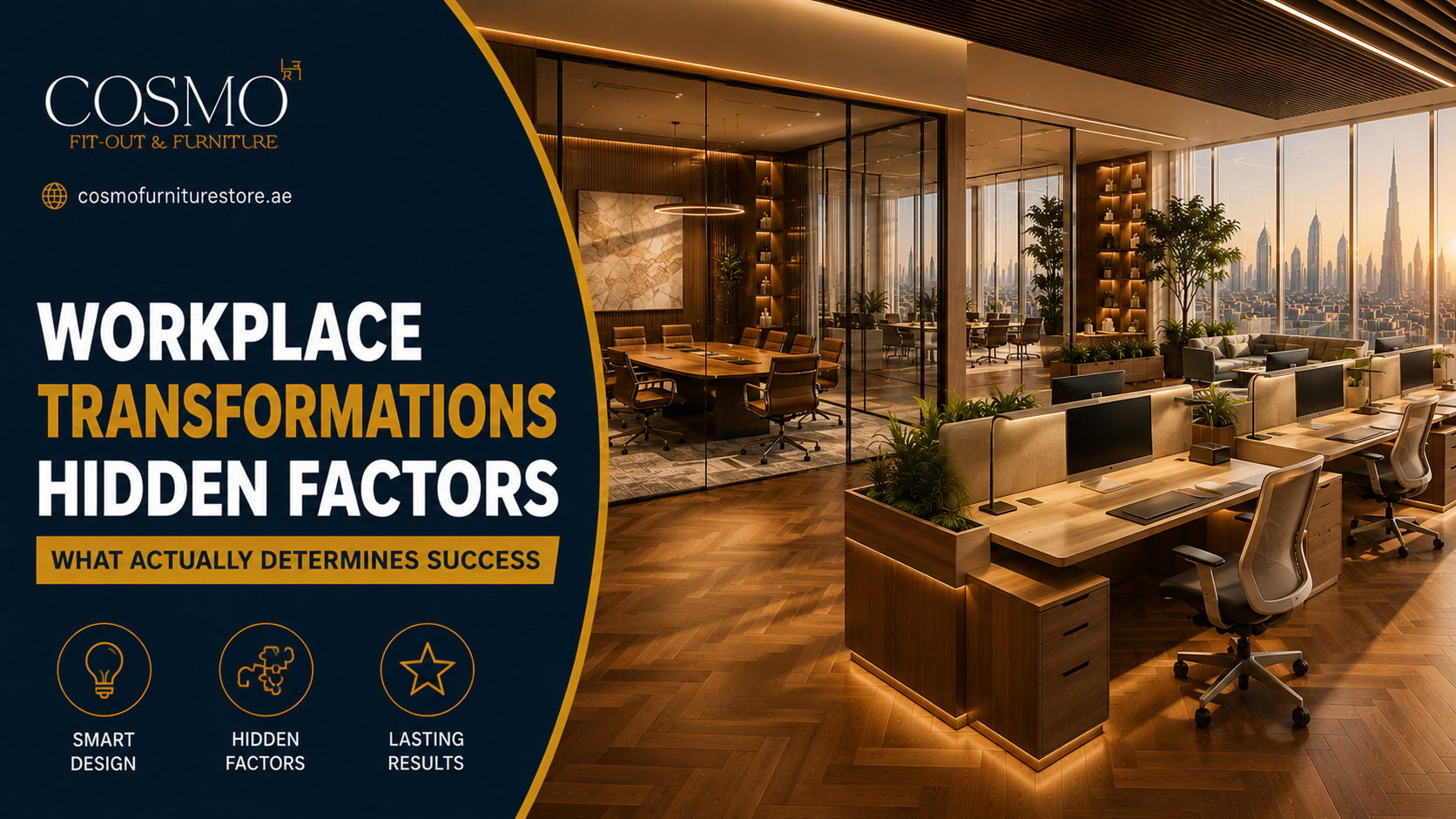
Every Dubai business that undertakes office renovation dreams of the same outcome — a workspace that motivates employees, impresses clients, and supports organizational growth. Yet the businesses that achieve genuinely successful workplace transformations consistently differ from those that don’t in one critical respect: they address the hidden factors that determine outcomes, not just the visible elements that dominate planning conversations. Furniture selection and floor layout are necessary components of any office project — but they are not sufficient. The factors that separate transformative results from merely cosmetic updates operate beneath the surface, in decisions that rarely appear in initial project briefs.
This guide examines the six hidden factors that consistently determine whether workplace transformations in Dubai deliver lasting business value or simply produce an attractive office that fails to change how the organization actually performs. At Cosmo Furniture Store, our 8+ years guiding modern office furniture in Dubai projects have shown us repeatedly that the most successful workplace transformations are won or lost in these overlooked details.
Why Most Workplace Transformations Underdeliver
The typical office renovation brief in Dubai focuses heavily on visible elements — furniture style, color palette, brand aesthetics, and floor plan efficiency. These elements matter, but they represent perhaps 40% of what actually determines whether workplace transformations succeed. The remaining 60% lives in factors that are harder to specify, harder to budget for, and consequently far more frequently overlooked in project planning.
This explains a pattern visible across Dubai’s commercial property market — offices that look impressive in photographs but fail to deliver the productivity, retention, or cultural improvements that justified the renovation investment in the first place. Genuinely successful workplace transformations require deliberate attention to factors beyond aesthetics — factors this guide examines in detail.
Hidden Factor 1: Understanding Actual Employee Workflow
The foundation of every successful workplace transformation is workflow understanding that goes beyond headcount and department lists. Employees who spend their working hours in a space have highly specific needs that vary significantly by role — needs that generic office planning consistently misses. Developers need extended uninterrupted focus periods. Sales teams need accessible collaboration zones and call privacy. Reception staff need visibility and efficient access to support resources. Executive assistants need proximity to leadership while managing competing demands on their time.
The workplace transformation projects that succeed begin with genuine workflow investigation — observing how teams actually work, where current friction points exist, and which roles have requirements that standard office planning assumptions don’t address. This investigation phase is frequently compressed or skipped entirely in rushed renovation timelines — and its absence is the single most predictable cause of workplace transformations that look impressive but function poorly for the people using the space daily.
Hidden Factor 2: Balancing Flexibility with Structure
The second hidden factor in successful workplace transformations is finding the precise balance between structural permanence and operational flexibility. Offices designed with excessive rigidity become functionally obsolete as soon as team structures, headcount, or work patterns change — a near certainty in Dubai’s fast-evolving business environment. Offices designed with excessive flexibility, conversely, frequently lack the spatial clarity and acoustic management that focused work requires.
Successful workplace transformations resolve this tension through modular furniture systems, reconfigurable meeting spaces, and adjustable workstation arrangements that provide structural clarity for daily operations while retaining the capacity to adapt as organizational requirements evolve. Quality modular Office Workstation Table Dubai systems exemplify this balance — providing the structural consistency that daily operations require while remaining genuinely reconfigurable as headcount and team composition change over the office’s operational lifespan.
Hidden Factor 3: Technology as a Silent Performance Driver
Technology integration is among the least visible but most consequential factors in workplace transformations that actually improve daily operations. Cable management systems that eliminate visible clutter, integrated power access that removes the friction of charging devices, and meeting room technology that works reliably without IT intervention — none of these elements photograph well for renovation marketing, yet they collectively determine whether an office feels genuinely professional or merely decorated.
The most successful workplace transformations treat technology integration as a core specification rather than an afterthought addressed during furniture installation. Workstations with built-in cable routing, meeting rooms with pre-configured AV systems, and reception areas with integrated visitor management technology all represent the invisible technology layer that distinguishes transformations that function smoothly from those that look good but create persistent daily friction.
Hidden Factor 4: The Underestimated Role of Lighting
Lighting design is consistently the most underestimated factor in workplace transformations — despite extensive research connecting lighting quality directly to employee focus, mood, and even physical health outcomes. Many Dubai office renovations specify furniture extensively while treating lighting as a secondary building services consideration handled separately from the overall design vision.
This separation is a fundamental mistake in workplace transformation planning. Natural light access, combined with carefully layered artificial lighting that avoids the harsh uniformity of standard fluorescent installations, creates the atmospheric quality that distinguishes genuinely transformed offices from spaces that simply received new furniture. The most effective workplace transformations integrate lighting design from the earliest planning stages — positioning workstations to maximize natural light access and specifying artificial lighting that complements rather than competes with daylight quality throughout the working day.
Hidden Factor 5: Aligning Design with Authentic Brand Identity
A successful workplace doesn’t just house employees — it expresses the organization’s actual identity to everyone who experiences it. This alignment between physical design and authentic brand values is a hidden factor that distinguishes meaningful workplace transformations from generic office updates that could belong to any organization regardless of industry or culture.
Workplace transformations that achieve genuine brand alignment require translating organizational values — innovation, heritage, collaboration, precision — into specific material, color, and spatial decisions rather than applying generic “modern office” aesthetics regardless of organizational character. A premium Modern Reception Desk Dubai selected to express specific brand values delivers more meaningful workplace transformation impact than an equivalent-cost piece selected purely for current design trends without consideration of what it actually communicates about the organization behind it.
Hidden Factor 6: Long-Term Vision Over Short-Term Trends
The sixth hidden factor separating lasting workplace transformations from short-lived renovations is the planning horizon applied to design decisions. Trend-driven specifications that look impressive at completion frequently lose relevance within 3-4 years as design trends shift — creating premature pressure for further investment that genuinely timeless workplace transformation planning avoids.
Organizations that achieve lasting transformation results consistently choose ergonomic, well-proportioned furniture in timeless material palettes over trend-chasing specifications that prioritize immediate visual impact. Quality Executive Office Desk Dubai configurations in classic proportions and quality materials maintain their relevance and professional impression for 10-15 years — delivering the sustained return on investment that genuinely successful workplace transformations require, rather than the 3-4 year relevance cycle that trend-driven specifications typically produce.
How These Hidden Factors Work Together
The six hidden factors examined in this guide do not operate independently — the most successful workplace transformations address them as an integrated system rather than a checklist of separate considerations. Workflow understanding informs which furniture arrangements actually serve daily operations. Flexibility planning determines whether technology integration can adapt as organizational needs change. Lighting design and brand alignment together create the atmospheric coherence that makes a space feel genuinely considered rather than merely furnished.
Quality meeting room furniture — like Best Meeting Room Chairs Dubai selected for both ergonomic performance and brand-appropriate material specification — demonstrates how individual furniture decisions can simultaneously address multiple hidden factors when workplace transformation planning treats them as interconnected rather than isolated specifications.
What This Means for Dubai Businesses Planning a Transformation
For Dubai organizations preparing to undertake their own workplace transformation, the practical implication of these hidden factors is straightforward: extend planning beyond furniture catalogs and floor plans before any procurement decisions are finalized. Specific steps that protect workplace transformation investment include:
- Conduct genuine workflow research before specifying any furniture — observe actual working patterns rather than relying on department headcounts alone
- Specify modular systems that allow reconfiguration as organizational structure evolves, rather than fixed arrangements that constrain future flexibility
- Treat technology integration as core specification from the earliest design phase, not an installation-stage afterthought
- Plan lighting alongside furniture rather than as a separate building services consideration handled independently
- Translate brand values into specific material decisions rather than applying generic contemporary aesthetics regardless of organizational identity
- Choose timeless quality over trend-driven specifications to protect investment value across the furniture’s full operational lifespan
Key Takeaways: Hidden Factors in Workplace Transformations
- Visible elements are necessary but not sufficient — furniture and layout matter, but successful workplace transformations require equal attention to workflow understanding, technology integration, lighting, brand alignment, and long-term planning.
- Workflow research is the foundation — workplace transformations that skip genuine investigation into how teams actually work consistently underdeliver regardless of furniture quality.
- Flexibility and structure must be balanced — modular systems that provide daily operational clarity while remaining reconfigurable protect workplace transformation investment as organizations evolve.
- Technology integration should be planned, not retrofitted — the most functional workplace transformations treat cable management and power access as core specifications from project inception.
- Lighting deserves the same attention as furniture — atmospheric quality created through deliberate lighting design distinguishes genuinely transformed offices from merely furnished ones.
- Timeless quality outperforms trend-chasing — workplace transformations built on classic proportions and quality materials deliver sustained value across a 10-15 year horizon rather than a 3-4 year trend cycle.
Frequently Asked Questions: Workplace Transformations
What makes workplace transformations successful in Dubai?
Successful workplace transformations in Dubai address six interconnected hidden factors alongside visible furniture and layout decisions: genuine employee workflow understanding, the right balance of flexibility and structure, deliberate technology integration, considered lighting design, authentic brand alignment, and long-term planning that prioritizes timeless quality over short-lived trends. Transformations that focus exclusively on visible aesthetics while neglecting these hidden factors consistently underdeliver on the productivity and cultural outcomes that justified the original investment.
How does lighting influence workplace transformations?
Lighting is one of the most underestimated factors in workplace transformations — directly affecting employee focus, mood, and physical wellbeing throughout the working day. Natural light access combined with carefully layered artificial lighting creates the atmospheric quality that distinguishes genuinely transformed offices from spaces that received new furniture without addressing the lighting environment those furniture pieces exist within.
Why should Dubai businesses invest in professional guidance for workplace transformations?
Professional guidance helps Dubai businesses navigate the hidden factors that determine workplace transformation success — translating brand values into specific material decisions, planning technology integration from project inception, and selecting modular systems that balance current functionality with future flexibility. Organizations that attempt workplace transformations without this expertise frequently focus exclusively on visible elements while missing the hidden factors that ultimately determine whether the investment delivers lasting results.
How often should workplace transformations be considered?
Most Dubai organizations should evaluate workplace transformation needs every 5-7 years, or sooner if the existing space no longer supports current employee performance requirements or has fallen out of alignment with evolving brand identity. Organizations experiencing significant headcount growth, cultural shifts, or brand repositioning often require workplace transformation consideration outside this typical cycle.
What’s the biggest mistake companies make in workplace transformations?
The most common mistake in workplace transformations is focusing exclusively on visual appeal — furniture style and color palette — while neglecting the hidden factors that determine whether the space actually functions better for the people using it daily. Comfort, genuine workflow alignment, technology integration, and long-term usability are consistently under-prioritized relative to their actual impact on workplace transformation success.
Where can Dubai businesses get expert help with workplace transformations?
Cosmo Furniture Store in Al Barsha 1, Dubai provides complete workplace transformation guidance — from workflow research and layout planning through furniture specification and technology integration. Our 8+ years of cross-sector Dubai experience means we understand exactly which hidden factors determine success for your specific organization. Our complete range — Office Workstation Table Dubai modular systems, Executive Office Desk Dubai configurations, Best Meeting Room Chairs Dubai, and Modern Reception Desk Dubai designs — supports every dimension of a successful workplace transformation. Call +971 55 145 2819 to schedule your free consultation.
Conclusion: Success Lives in the Details Most Projects Overlook
The real success of workplace transformations doesn’t lie in flashy furniture or impressive renovation photography — it lies in the hidden factors that most projects overlook entirely. Employee-centered workflow planning, the right balance of flexibility and structure, thoughtful technology integration, deliberate lighting design, authentic brand alignment, and long-term vision over short-term trends together determine whether a renovated office becomes a genuine performance asset or simply an attractive space that fails to change how the organization actually operates.
In Dubai’s competitive business environment, these hidden factors are where workplace transformations are genuinely won or lost. The organizations that address them deliberately — rather than focusing exclusively on the visible elements that dominate typical renovation conversations — are the ones that achieve workplace transformations that drive culture, performance, and growth for years beyond the completion date.
At Cosmo Furniture Store, we help Dubai businesses address every hidden factor that determines workplace transformation success — not just the furniture and layout decisions that are easiest to specify. Visit our Al Barsha 1 showroom, explore our modern office furniture in Dubai collection, or call +971 55 145 2819 — and let us help you build a workplace transformation that delivers results long after the installation team has left.
Visit Our Showroom: Pin Location 📍
In Case You Missed These Posts:
- The Hidden Factors Behind Successful Workplace Transformations
- From Vision to Reality: Designing Workspaces That Inspire Productivity
- Inside the Makeover: How Dubai Businesses Are Redefining Professional Spaces
- How Can a Fitout Company Transform Your Spacе?
- Why Do You Need Office Furniture?
- The Importance of Fitout Services in Dubai for Modern Office Design
- Dubai’s Top Interior Design Services for Modern Spaces
- What Wood is Used for Furniture: Best Type to Choose for Office
- Zoning Workspaces with Innovative Furniture
- Can Interior Designers Help with Eco-Friendly Solutions?